A Trie-ing Effort: Leveraging Prefix Trees for Smart Lookup
#Programming
#DSA
#Optimization
Introduction
When working with backend systems, especially those dealing with large volumes of string data, efficient lookups become critical. Whether it's autocomplete, suggestions, routing, or validations, traditional data structures like arrays or hash maps often fall short.
A Trie (Prefix Tree or Digital Tree) is a specialized tree-based data structure designed to store and retrieve strings from a dictionary or a set. It stores strings in a way that allows shared prefixes to be reused, enabling fast and predictable lookup operations.
How Tries Work
A trie is essentially a tree where:
- Each node represents a character.
- Each path from the root to a marked node spells out a complete word.
- Each path from the root to any intermediate node forms a valid prefix.
Unlike a binary search tree that stores the entire key at a node, a trie distributes the key across the edges of the path. The root itself holds no character it is simply the entry point.
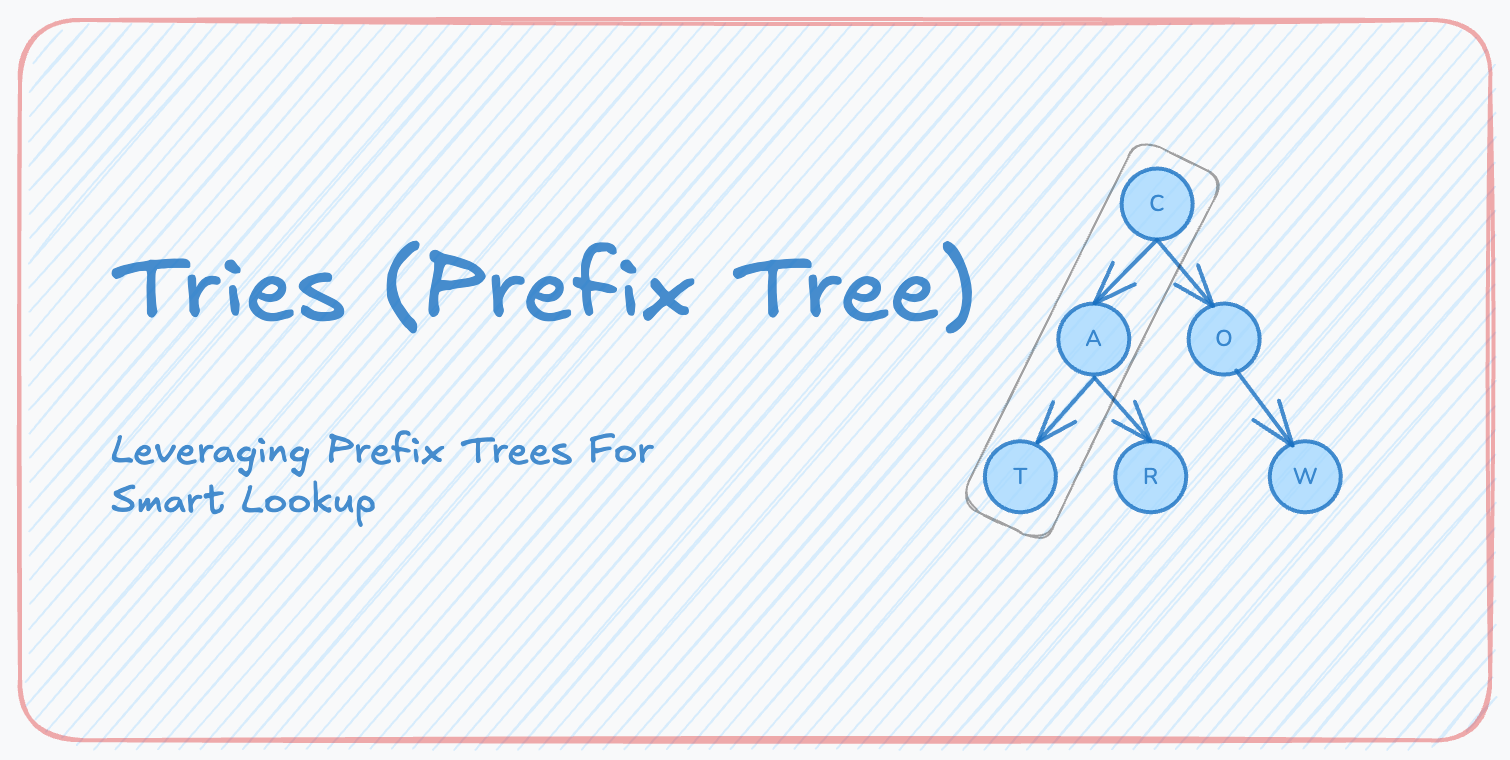
Example — inserting the words cat, car, and cow:
        (root)
          |
          c
         / \
        a   o
       / \   \
      t   r   w
    [cat][car][cow]
cat and car share the prefix ca, so they share the same c → a path and only diverge at the third character.
cow shares only c with the others. This prefix sharing is the core efficiency of a trie common prefixes are stored once, not duplicated.
Each node typically contains:
- A map or array of child pointers (one per possible character).
- A boolean flag
isEndOfWordto mark where a complete word ends.
The isEndOfWord flag is what distinguishes a prefix from a full word. For example, if you insert car and card, the node at r has isEndOfWord = true (marking car), and the node at d also has isEndOfWord = true (marking card). Without this flag, you couldn't tell the difference between the two.
Core Operations
Insert
Walk the trie character by character. For each character, move to the existing child node or create a new one. At the final character, set isEndOfWord = true.
Search
Traverse the trie using each character of the target string. If at any point a child node doesn't exist, the word is absent. If you reach the last character, check isEndOfWord — true means the word exists, false means it's only a prefix of something longer.
Prefix Search
Same traversal as search, but stop at the last character of the prefix. If all nodes along the path exist, the prefix is present — no need to check isEndOfWord.
Autocomplete
Navigate to the node at the end of the given prefix, then run a DFS or BFS from that node, collecting every path that terminates at a node where isEndOfWord = true. Each such path, prepended with the original prefix, is a valid suggestion.
Time Complexity
| Operation | Complexity |
|---|---|
| Insert | O(m) |
| Search | O(m) |
| Prefix Search | O(m) |
| Autocomplete | O(m + k) |
- m = length of the string
- k = number of results returned
Why Tries?
Let's compare tries with traditional hash maps or database indexes.
Traditional approach:
- Hash maps offer fast lookup but no prefix awareness.
- Arrays or lists require full scans for prefix queries.
- SQL
LIKE 'prefix%'is inefficient at scale without specialized index structures.
With Tries:
- Efficient prefix search.
- Autocomplete support out of the box.
- No hash collisions.
- Lexicographically ordered traversal.
Real-World Use Cases
Tries can be used across multiple domains where prefix-based lookup and pattern matching are required.
Autocomplete Systems
- Search bars (Google, YouTube, e-commerce platforms)
- IDE suggestions and code editors
- Username availability checks — quickly verify if a username exists and suggest alternatives based on a shared prefix.
Instead of scanning all records, tries jump directly to the prefix node.
API Routing and Longest Prefix Match
Tries are used in API gateways, reverse proxies, and network routers (IP routing tables) to match the most specific route efficiently. Routers use binary tries to perform longest prefix matching on IP addresses for fast routing decisions.
api/user/*
api/user/profile
A request to api/user/profile will correctly resolve to the more specific route rather than the wildcard.
Spell Checking and NLP (AI / Linguistics)
- Dictionary lookup
- Autocorrection systems
- Word suggestion engines
Used in tools like Grammarly, search engines, and word-based games to suggest corrections and completions with minimal latency.
Genome Sequencing (Bioinformatics)
DNA sequences are strings over the alphabet: A, C, G, T. Tries help store large genome datasets and perform fast subsequence and pattern matching, which is critical in tasks like read alignment and motif discovery.
File Systems and Search
Tries are used for file path indexing and efficient directory traversal, such as tab-completion in shells or IDE file explorers.
/home/user/docs
/home/user/downloads
Across all these domains, the common thread is the same: efficiently finding strings that start with a given prefix.
Optimization Variants
There are several structures built around or inspired by tries, each addressing specific constraints:
- Compressed Trie (Radix Tree): Merges chains of single-child nodes into one edge, drastically reducing memory usage and node count. Used in Linux kernel routing tables and HTTP routers like
httprouter. - DAWG (Directed Acyclic Word Graph): Shares not just prefixes but also suffixes, reducing duplication across the entire structure. Ideal for static dictionaries like spell checkers.
- Ternary Search Tree (TST): A memory-efficient hybrid of a trie and a binary search tree. Each node has three children (less, equal, greater), making it cache-friendlier with lower memory overhead.
- HAT-Trie: A cache-conscious variant that combines tries with hash array-mapped tables. Offers near hash-map speed for lookups while retaining prefix-search capabilities. Well-suited for large in-memory string stores.
- Burst Trie: Starts as a trie and dynamically "bursts" high-traffic leaf nodes into small containers (like hash maps) as they grow. Balances memory and speed adaptively at runtime.
- Bitwise (Binary) Trie: Operates on individual bits rather than characters. Used in network routing for IP address lookups and in low-level systems programming where binary prefix matching is required.
When Not to Use Tries
Tries are powerful, but they aren't always the right tool.
- Small datasets: For a few hundred or thousand strings, a sorted array with binary search or a plain hash map will be faster in practice due to lower overhead and better cache locality.
- Non-string or non-prefix workloads: If your lookups are purely exact-match (no prefix or autocomplete needs), a hash map will almost always outperform a trie with less complexity.
- Memory-constrained environments: Tries can be memory-hungry, especially for sparse datasets with long strings and little prefix overlap. Each node carrying child pointers adds up quickly. Consider a compressed trie or TST in such cases.
- Infrequent mutations on a static dataset: If the dataset rarely changes and you only need lookups, a sorted array, a DAWG, or a precomputed FST (Finite State Transducer) may be more efficient and compact.
- Unicode or large alphabets: Standard tries assume a small, fixed alphabet. For full Unicode strings, the branching factor explodes. A ternary search tree or a hash-map-per-node approach handles this better.
Implementation
To bring this into a real-world context, I built a simple Trie-powered username system that combines efficient lookup, autocomplete, and static suggestion strategies. You can explore the implementation here: https://github.com/senor101/username-tries
Conclusion
Tries are one of those data structures that, once understood, appear everywhere, from the search bar you use daily to the routers that direct your network packets. Their ability to share prefixes makes them uniquely efficient for string-heavy workloads where prefix awareness matters.
That said, like any tool, their value depends on the problem. A trie shines when you need fast prefix search, autocomplete, or longest-prefix matching over a large string set. It struggles when memory is tight, the dataset is small, or the workload is purely exact-match.
References
https://en.wikipedia.org/wiki/Trie
https://www.geeksforgeeks.org/dsa/trie-insert-and-search/
https://medium.com/basecs/trying-to-understand-tries-3ec6bede0014